
- All
- Product Name
- Product Keyword
- Product Model
- Product Summary
- Product Description
- Multi Field Search
Please Choose Your Language
Views: 0 Author: Site Editor Publish Time: 2026-10-24 Origin: Site


High-speed permanent magnet motors deliver exceptional power density and exceptional efficiency. Their highly compact size and rapid rotational speeds create a critical engineering bottleneck. They generate extreme thermal density. Unmanaged heat leads directly to efficiency degradation. It causes premature bearing failure and triggers irreversible demagnetization of the rotor. Choosing the right cooling method is never a mere preference. It remains a fundamental operational requirement for system stability.
Deciding between air and liquid thermal management requires careful analysis. You must balance spatial constraints, challenging environmental conditions, and facility infrastructure readiness. This comprehensive guide provides an evidence-based framework. It helps you evaluate the optimal thermal management system for your high-speed applications. You will learn the mechanical differences, strategic advantages, and strict operational limitations of both cooling methods. We will explore how to align your specific choice directly with your demanding industrial application needs.
Thermal Limits: A high speed permanent magnet motor requires aggressive cooling due to heightened eddy current losses and windage friction.
Air Cooling: Best for environments with ample space, clean ambient air, and lower initial infrastructure budgets.
Water Cooling: Essential for applications requiring maximum power density, strict environmental sealing (high IP ratings), and precise thermal control.
TCO Impact: While water cooling carries higher upfront infrastructure costs, its operational efficiency and footprint reduction often yield a faster ROI in heavy-duty industrial applications.
Heat is the primary enemy of any electrical machine. High-speed operation magnifies this issue significantly. Understanding the physics behind this heat generation helps you appreciate the necessity of robust cooling. You can then protect your investment effectively.
Increased RPMs exponentially increase internal resistance and friction. High speed motors face unique aerodynamic challenges. The spinning rotor interacts aggressively against the surrounding air inside the stator gap. This creates immense windage friction. Windage drag scales with the cube of rotational speed. High-frequency electrical switching also creates severe core losses. Eddy currents form within the stator steel and the rotor magnets. These circulating currents generate massive thermal energy right at the core of the machine. You must extract this heat continuously.
Permanent magnets rely on specific atomic alignments to maintain their magnetic flux. Neodymium magnets power most modern high-speed applications. They possess a strict Curie temperature threshold. Exceeding specific thermal limits causes irreversible damage. The magnetic domains lose their alignment permanently. We call this irreversible demagnetization. Once a magnet loses its flux, the motor loses torque permanently. You cannot reverse this damage. The motor will draw excessive current trying to compensate. This rapid current spike ultimately destroys the drive or the motor windings.
Excess heat attacks the fundamental mechanical components. Stator windings rely on thin enamel insulation. We typically classify these insulating resins under Class F or Class H thermal limits. Continuous heat exposure degrades this resin quickly. The insulation eventually cracks, causing a catastrophic short circuit. Bearings also suffer under extreme temperatures. The lubricating grease vaporizes or loses its viscosity. Metal grinds against metal. This leads to rapid and premature mechanical failure. Effective cooling prevents these cascading failure modes entirely.
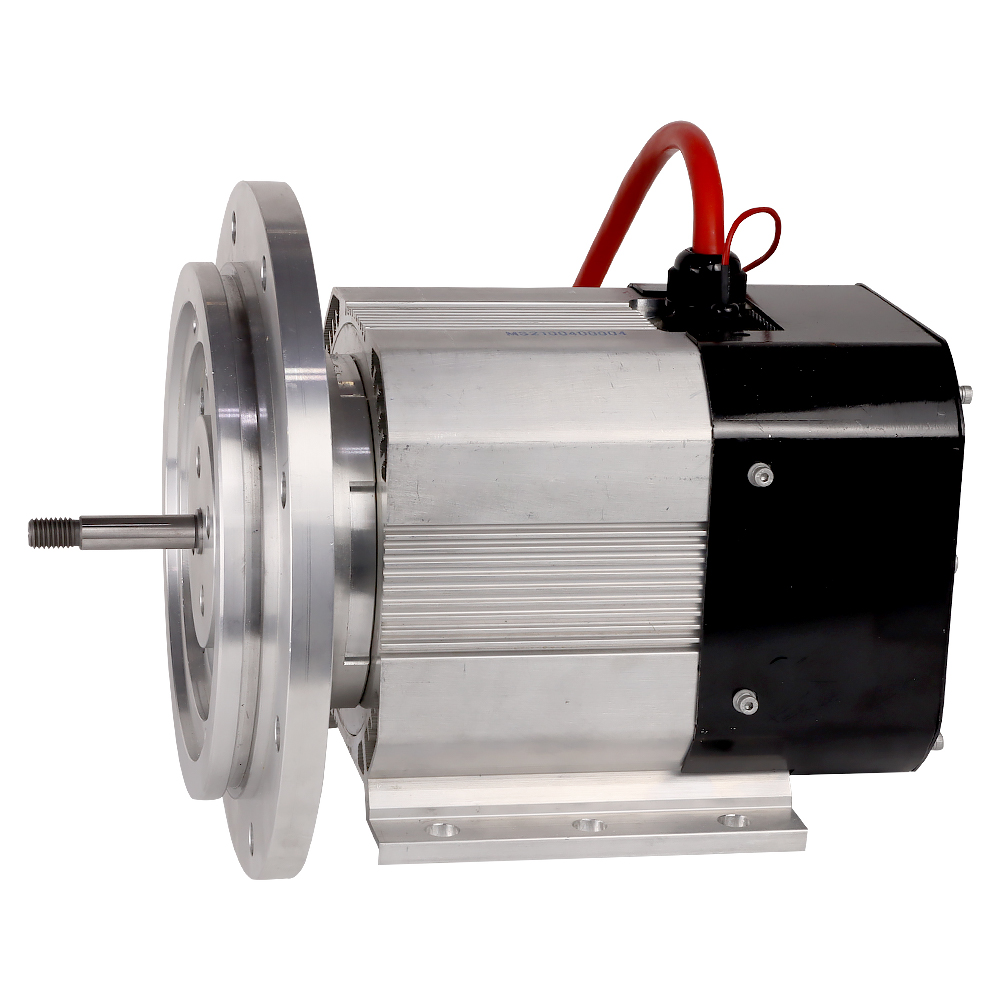
Air cooling relies on the surrounding atmosphere to absorb and carry away internal heat. Engineers often specify an air-cooled permanent magnet motor for applications prioritizing simplicity. Let us examine the mechanisms and trade-offs.
Most industrial air-cooled machines use a Totally Enclosed Fan Cooled (TEFC) design. A fan mounts directly to the rear shaft. It blows ambient air over external cooling fins. Another method is forced-ventilation. Forced-ventilation uses an independent, motorized blower. This blower pushes air across the motor regardless of the main shaft speed. This ensures constant airflow even during low-speed operation.
Simplicity and Reliability: Air cooling uses no circulating liquids. It carries absolutely zero risk of fluid leaks. You do not need external chilling infrastructure.
Lower Initial Cost: This approach reduces initial capital expenditure. Facilities without existing chilled water loops benefit greatly from this simplicity.
Maintenance Profile: Routine maintenance remains minimal. Technicians only need to inspect fan blades and replace ventilation filters periodically.
Larger Footprint: Air possesses poor thermal conductivity compared to liquids. The motor requires a significantly larger frame size. It needs massive external fins to achieve the necessary surface area for heat dissipation.
Environmental Sensitivity: Ambient room temperature directly limits cooling capacity. If the room gets hot, the motor gets hot. Dusty or corrosive environments necessitate frequent filter changes. Airborne debris easily clogs cooling fins.
Acoustic Noise: High-velocity cooling fans generate substantial industrial noise. A shaft-mounted fan spinning at 24,000 RPM creates deafening aerodynamic roar. This often violates workplace noise regulations.
Table 1: Air Cooling vs. Water Cooling Attributes
Cooling Attribute | Air-Cooled Motors | Water-Cooled Motors |
|---|---|---|
Thermal Conductivity | Low (Requires large surface area) | High (Allows compact design) |
Physical Footprint | Significantly larger frame | Extremely compact and lightweight |
Ingress Protection | Typically IP54 / IP55 | Up to IP67 (Fully sealed) |
Acoustic Noise | High (Aerodynamic fan noise) | Very Low (No fan required) |
Maintenance Needs | Filter cleaning, fan inspection | Coolant chemistry checks, seal audits |
When physical space vanishes and power demands peak, liquid cooling becomes mandatory. A water-cooled permanent magnet motor offers unparalleled thermal extraction capabilities.
Water-cooled designs utilize liquid circulation through a customized water jacket. Manufacturers integrate this jacket directly into the motor housing. Coolant absorbs heat from the stator core. A pump pushes the heated fluid out to a remote heat exchanger. The chilled fluid then returns to the motor. This continuous loop provides aggressive, highly controlled thermal management.
Maximum Power Density: Water boasts superior thermal conductivity. It transfers heat exponentially faster than air. This allows the motor to be significantly smaller and lighter than an air-cooled equivalent at the same exact kilowatt rating.
Environmental Isolation: Water jackets allow for fully enclosed designs. Manufacturers easily achieve IP55 or IP67 ratings. This protects internal electrical components from atmospheric contaminants. Moisture, dust, and corrosive gases cannot penetrate the housing.
Predictable Thermal Stability: Liquid systems operate independently of ambient room temperatures. You can control the coolant supply temperature precisely. This allows for continuous, uninterrupted operation at peak loads in sweltering industrial environments.
Infrastructure Dependency: Liquid cooling requires a reliable, treated water supply. You must install a dedicated closed-loop chiller system. Plumbed pipes, pumps, and valves add facility complexity.
Leakage Risks: Introducing fluids near high-voltage electrics always carries risk. It introduces the severe threat of fluid entering the electrical housing if internal seals degrade. A leak often results in immediate stator failure.
Maintenance Complexity: Technicians must monitor coolant quality constantly. They must verify flow rates and check pressure drops. Neglecting fluid chemistry leads to scaling or corrosion inside the water jacket.
Selecting the optimal method requires a structured evaluation of your operational constraints. We break this down into three critical decision pillars.
Physical space often dictates the cooling choice immediately. If your installation footprint is highly restricted, liquid cooling is non-negotiable. Integrated compressors, aerospace testing rigs, and marine propulsion systems demand maximum power in minimal volume. A water-cooled frame shrinks the physical dimensions dramatically. Conversely, if space is abundant and frame size is irrelevant, air cooling offers a path of lesser resistance. You avoid plumbing entirely.
You must assess the ambient air quality around the installation site. Airborne particulates, textile fibers, or chemical vapors heavily penalize air-cooled systems. Fans suck dirt directly into the cooling fins. The buildup acts as a thermal blanket, suffocating the motor. Liquid-cooled systems isolate the motor thermally and mechanically from hostile surroundings. If you operate in a paper mill, a mine, or a chemical plant, sealing the motor via a water jacket ensures survival.
Evaluate your existing facility utilities carefully. Piggybacking on an existing industrial chilled water loop drastically reduces the initial capital expense of a water-cooled setup. If you already have chilled water lines nearby, tapping into them makes sense. Calculate your accepted maintenance downtime. Air cooling requires frequent, somewhat disruptive filter checks. Water cooling requires periodic pump, seal, and fluid chemistry audits. You must ensure your maintenance crew possesses the right skills for your chosen system.
Theoretical advantages mean little if implementation fails. Both systems carry specific adoption risks. You must mitigate these risks proactively during the installation phase.
Water-cooled systems require specific fluid chemistry. You cannot use standard untreated facility tap water. Tap water contains minerals like calcium and magnesium. These minerals precipitate out of the water at high temperatures. They form hard scale inside the motor's water jacket. Scaling acts as a powerful thermal insulator. It destroys cooling efficiency rapidly and causes the motor to overheat. Always use deionized water or specific manufacturer-approved glycol mixtures.
Liquid cooling introduces a hidden danger: internal condensation. If the coolant temperature drops below the ambient room dew point, moisture forms. Water droplets condense directly onto the internal stator windings. This moisture breaks down the insulation over time. You must manage this risk carefully. Engineers often install anti-condensation heaters inside the motor housing. They also program the chiller to track ambient temperature and adjust the coolant supply accordingly.
High-speed applications rely on Variable Frequency Drives (VFDs) for precise control. You must address how cooling methods scale across the motor's entire operational speed range. A shaft-mounted cooling fan only moves air effectively at high speeds. During low-speed, high-torque phases, a shaft-mounted fan provides insufficient airflow. The motor will overheat quickly. If your application requires prolonged low-speed operation, you must specify an independent forced-air blower or choose a water-cooled design.
The choice between air and liquid thermal management is never binary. It is dictated entirely by the intersection of your operating environment, spatial limits, and budget. High-speed motors demand rigorous heat extraction to prevent demagnetization and mechanical failure.
Air-cooled designs deliver unmatched simplicity and lower upfront facility costs. They shine in clean environments where space remains plentiful. Conversely, water-cooled designs unlock massive power density and environmental isolation. They are indispensable for compact, extreme-duty applications.
Your next steps should focus on actionable data gathering. Finalize your specific load profiles and torque requirements. Assess your facility utility readiness, specifically checking for existing chiller capacity. Consult with motor manufacturers directly. Ask them to run thermal simulation models based on your exact duty cycle before you finalize the motor specifications.
A: Yes. Magnetically and electrically, they can be identical. Both designs can deliver exceptional efficiency ratings. However, the air-cooled variant will require a much larger physical frame to dissipate the equivalent heat generated by those electrical processes.
A: Thermal runaway occurs within minutes due to the extreme power density. The stator and magnets overheat rapidly. Thermal sensors like PT100 or PTC thermistors must be wired directly to the drive. They must trigger an immediate emergency shutdown to prevent destruction.
A: Yes. Water-cooled motors eliminate the aerodynamic noise of high-velocity cooling fans. This makes them substantially quieter. They are highly preferable for noise-restricted environments, laboratories, or enclosed factory floors.
A: Air-to-water heat exchangers, known as TEWAC systems, exist for very large industrial motors. They combine enclosed internal air circulation with liquid-cooled radiator coils. This effectively isolates the internal motor environment while utilizing liquid cooling efficiency.


